Table of Contents
The analogue world
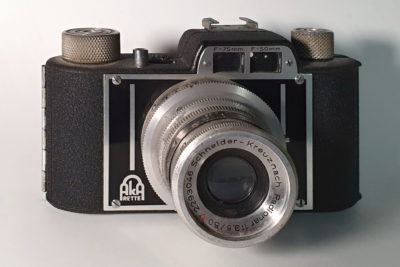
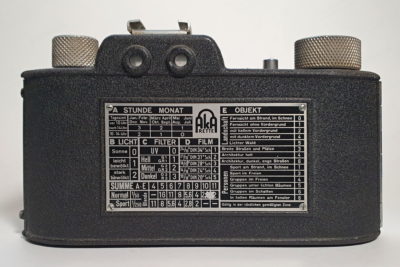
Akarette 0 unit number 22077
Our first camera was an Akarette 0 built in 1949 with the lens Schneider-Kreuznach 1:3.5 / 50 mm No. 2293048. The Akarette is a 35mm viewfinder camera with interchangeable lenses and switchable viewfinder between 50 and 75mm focal length.
The camera was in use until the mid-1970s. The films used were Agfa and Kodak colour negative films, usually 100 ASA. The camera was built by AkA Apparate & Kamerabau GmbH Friedrichshafen. The company was founded in February 1946 as AkA Apparate und Kamerabau GmbH in Bad Wildbad / Black Forest. At the beginning of April 1949, the company moved to Friedrichshafen / Lake Constance. In 1957, the company was renamed Apparate und Kamerawerk GmbH. After bankruptcy in September 1960, Arette Feinwerktechnik GmbH was founded. The company went out of business for good in 1963.
Agfamatic 1000 pocket sensor
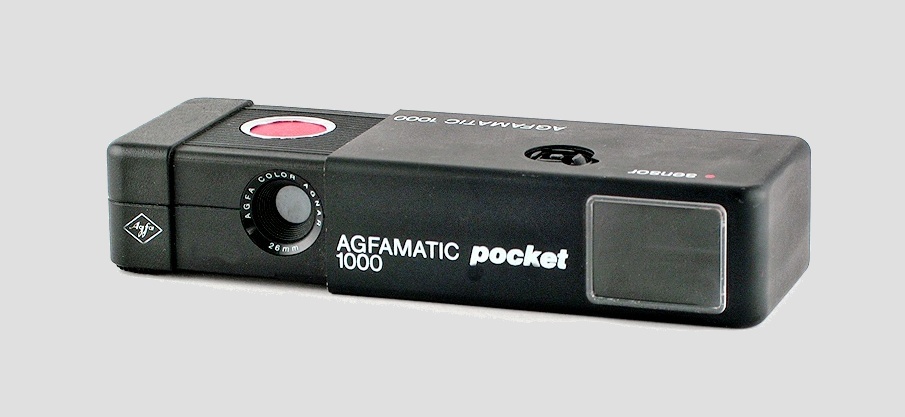
The Akarette was followed in 1974 by the Agfa Agfamatic 1000 pocket sensor, an easy-to-use and extremely compact pocket camera for 110 pocket film in 13 * 17mm format. No great demands were made on the picture quality. The camera was built until 1976.
We used the camera until the end of 1979.
Carena SRH-1000
Our first mirror reflex chamber was a Carena SRH-1000 from Photo Porst (1979). The lenses had to be screwed onto the 42mm thread.
The camera was launched in 1978 and was a 35mm 35mm CDS/TTL SLR camera. The lens mount was based on an M42 thread. A cloth focal plane shutter, horizontal release with shutter speeds 1- 1/1000 sec and Bulb were a modern feature for the time. A Carenar 1.7/50mm standard and a 2.8/135mm telephoto lens were available. The films we used were Kodak colour negative and colour slide films, usually 100 ASA.
Pentax ME
Back in 1981 we decided to buy a Pentax ME SLR camera. At that time, there were several well-known 35 mm SLR camera manufacturers with similar features. The decision criterion for the Pentax ME was the compact size, the automatic mode and of course the bayonet mount for the lenses.
The market launch took place in 1976 and the camera was produced until 1981. The camera already had an aperture priority (Av) with an exposure mode but with the possibility of an exposure correction of +/- 2 EV. Av, X and B modes were available. With a centre-weighted metering range, shutter speeds of 1/1000 – 8sec and Bulb were available. Exposure metering was TTL (Through the Lens) with open aperture.
The lenses were connected via a Pentax K bayonet, which was introduced with the Pentax ME, among others, and allowed the construction of compact lenses.
The lenses used were an SMC Pentax-M standard lens 1.7/50mm, an SMC Pentax-M telephoto lens 3.5/135mm and a Tokina telephoto zoom 4.5/80-200mm.
Pentax ME Super
After a mechanical defect of the Pentax ME, we decided to buy the successor model Pentax ME Super in 1984.
The Pentax ME Super was built as a further development of the Pentax ME from 1980 to 1987. Shutter speeds of 1/2000 – 4sec and Bulb were now available. The automatic mode could be used over the entire exposure time and also well beyond 4sec. A robust metal focal plane shutter from Seiko was now built in. The film speed could be set from 12-1600 ASA.
The lenses used were still an SMC Pentax-M standard lens 1.7/50mm, an SMC Pentax-M telephoto lens 3.5/135mm and a Tokina telephoto zoom 4.5/80-200mm.
Pentax A3
The Pentax ME-Super served us well for 3 years. After a mechanical defect, we bought a Pentax A3 in 1987. The reason for buying it was, of course, the Pentax K bayonet mount.
Built until 1988 …Further development of the Pentax ME-Super …
The lenses used were still an SMC Pentax-M standard lens 1.7/50mm, an SMC Pentax-M telephoto lens 3.5/135mm and a Tokina telephoto zoom 4.5/80-200mm.
Konica Lexio W70
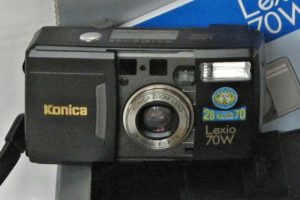
2000 – The last analogue KB camera purchased, 27-70mm. Handy and for this compact analogue camera you got relatively good photos.